Frazor2
Frazor and Frazor2
Developing a strawberry harvesting robot.
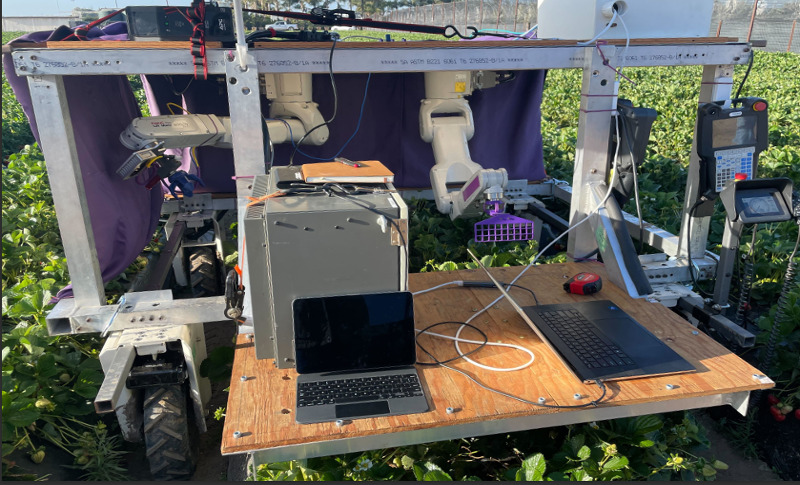 Frazor, a strawberry harvesting robot.
The Problem
Strawberries are the second most popular fruit in the U.S., but harvesting them is costly and labor-intensive, with labor expenses rising 50% in six years. No automation company has yet delivered an affordable solution, especially for late-season picking when dense foliage hides the berries. L5 Automation is developing a robotic harvester using off-the-shelf hardware and custom software, designed to work with standard farm layouts. Our prototype uses multiple robotic arms and cameras to move leaves and pick ripe strawberries.
NSF SBIR Phase I: Trajectory Optimizations and Learned Foliage Manipulation to Accelerate Throughput in Automated Strawberry Harvesting
When professional human harvesters pick strawberries in the field, they use their hands to push foliage out of the way and will naturally move their heads around to get different vantage points. This enables them to see, identify and reach the ripe berries on the bed which are often hidden under thick, mature plants during the peak of the season for strawberry harvesting. An autonomous harvesting system needs to deal with the same challenges: foliage needs to be moved out of the way and various vantage points need to be collected to ensure that all the ripe berries on the bed can be found and picked. Supported by the National Science Foundation (NSF), our work focuses on two main challenges: optimizing robot movement based on perception, and teaching robots to manipulate foliage using real-world data.
Our goals
L5 Automation’s research into perception-aware trajectory optimization sought improvements in the motion planning for a robotic arm equipped with a camera on the end effector (eye-on-hand). The goal was to identify poses of the arm which allow the camera to capture images from various perspectives to improve the software’s knowledge of the volumetric occupancy of the scene including the positions of the plants and strawberries. Once worthwhile poses were identified, this research also investigated ways to efficiently move the camera by running optimization algorithms that find minimum distance paths to visit those poses. Our research also showed how additional static cameras can be beneficial in more quickly establishing an initial understanding of the environment. These developments are a necessary first step to creating highly efficient trajectories which will enable high-speed harvesting.
However, if there is still foliage in the way, getting several different views may not be enough. In the second part of this research, L5 focused on learning how to manipulate foliage to effectively expose strawberries that would otherwise be hidden. Experiments were run to robotically manipulate the plants without damaging them and observe the effects on visibility and picking access for the revealed volume. Along the way, we developed a custom paddle-shaped end effector which could be used to gently push the foliage out of the way and expose strawberries underneath the plants’ canopies --- both to see them and to reach in and pick them. From the data generated by the experiments, we were able to train neural networks to calculate optimal foliage interactions to reveal the area beneath the leaves. Once the area beneath the foliage is revealed, the second arm with the camera can collect additional views to detect previously hidden berries and improve the location estimates for those where only glimpses were seen before. This is necessary to allow an autonomous harvester to succeed during the peak of the strawberry season which is when the need is most acute for growers to augment their labor force.
What we accomplished
Through this NSF funded work, we have advanced the state-of-the-art in both perception-aware planning and automated foliage manipulation. While searching around and under plants for ripe berries is simple for humans to perform, it is not a task that robots can be easily configured and programmed to accomplish. Through this research L5 has been able to “teach our robot new tricks”, demonstrating what no autonomous system has reliably done before: picking under heavy foliage and paving the way for an autonomous harvesting system that will meet the needs of strawberry growers across the United States.
Below you can watch a demonstration of our NSF-funded prototype in action. This video highlights the robot’s ability to push foliage aside and pick strawberries that would otherwise be hidden, showcasing the results of our research into perception-aware planning and foliage manipulation.
Frazor2: Building on NSF Insights
Frazor2 is the direct follow-up to our NSF-funded research, where we applied the key lessons learned about perception-aware planning and foliage manipulation. While our initial prototype proved that robots could pick strawberries hidden under dense foliage, it also revealed limitations in how the system could simultaneously manipulate and harvest across the entire bed.
With Frazor2, we redesigned the robot from the ground up, focusing on enabling both arms to reach anywhere on the bed for true “full bed” pick capability. This new design overcomes the restricted overlap of the previous version, allowing for more coordinated manipulation and picking—even in the most challenging, foliage-dense conditions. By integrating the insights and techniques developed during the NSF project, Frazor2 represents a significant step forward in automated strawberry harvesting. We are excited to see how these improvements translate to real-world performance!
Below are several videos showcasing Frazor2 in action. The first video demonstrates the assembly and driving of the new robot. The second captures the first pick of the 2025/26 season, and the third is a promotional video created for CalPoly Field Day, highlighting the robot’s capabilities in a real-world setting.